Carrion
- 4.2
- Rating
- 1.00M
- Installs
- Free
- Price
 Analysis by App-foxy
Carrion immediately puts me in an unusual position for an action game: I am not trying to escape the monster, protect a settlement, or become a decorated hero. I control the thing people are afraid of. That reversal gives the whole experience a sharp identity from the first moments, but the game is more than a simple “play as the creature” idea. Its pixel art, sound, enclosed environments, and steadily changing pace all work together to make movement feel dangerous, hungry, and strangely satisfying.
This is a free action game from DevolverDigital, aimed at a mature audience with an age rating of Mature 17+. It arrived on October 30, 2024, and the current version is 1.0.44, with Android support from version 6.0 onward. Its store summary is “HUNT. CONSUME. GROW. EVOLVE.”, but my experience is that the appeal comes from how those verbs connect: hunting creates opportunities to consume, consuming helps me grow, and growth changes how I approach the next room rather than simply making every encounter easier.
With an average rating of 4.2 from around 28 thousand ratings and over one million installs, it has clearly found an audience beyond a small experimental niche. I can understand why. The game has a strong visual hook, but it also asks me to learn its spaces, read enemy behavior, and decide when raw aggression is a mistake. It is best approached as a compact, mood-heavy action experience rather than as a relaxing mobile time-filler.
You May Also Like

 Blood Strike: 2.5 Anniversary
Blood Strike’s Loadouts Turn Every Drop Into a Tactical Gamble
A close look at Blood Strike’s custom loadouts: how fast access to signature weapons reshapes its battle royale rhythm, rewards preparation, and narrows the gap between fights.

 Pandora - Music & Podcasts
Pandora’s Music Is Easy to Start, but Harder to Recover
Pandora’s strength is its low-effort path from a seed to a station. Its weak spot is how much confidence it asks you to place in connection, setup, and quiet recovery.

 8 Ball Pool
 Is Built on Rivalries, Rematches, and Routine
A close look at the rivalries, rematches, shared routines, and unanswered safety questions that turn a quick pool match into a persistent mobile community.

 Samsung Music
’s Quiet Strength Is Playing What You Already Own
Its reach comes less from spectacle than from dependable access to a personal library. That simplicity is both the app’s strongest retention engine and its ceiling.

 AccuWeather: Weather Radar
AccuWeather Review: A Quick, Clear Forecast for Everyday Decisions
For everyday plans, the best forecast is the one you can understand quickly. AccuWeather makes rain timing, radar, and local conditions easy to act on, with a few trade-offs.

 Hill Climb Racing
Why Hill Climb Racing Still Turns Crashes Into One More Run
A tiny car, a bumpy hill and one more upgrade: Hill Climb Racing keeps resurfacing because its simple chaos makes every near-miss feel personal.
More From Our News Desk



A first impression built around controlled menace
The opening impression is effective because the creature’s movement communicates character before the game needs to explain much. I am not guiding a neat, human-shaped avatar across a bright platforming course. I am directing an unstable mass that stretches, curls, lunges, and occupies space in a way that feels deliberately uncomfortable. The animation sells the fantasy of being something alive and hostile without relying on lengthy exposition.
That perspective changes the usual emotional rhythm of an action game. In many similar titles, I enter a room and immediately search for cover, ammunition, or a safe route. Here, I often enter while thinking about angles, prey, and escape paths. The environment is not just a background around the action. It is the surface through which the creature moves and the puzzle that determines whether a violent encounter goes smoothly or becomes a chaotic retreat.
The first few encounters also establish an important limitation: being the monster does not mean being invincible. Human opposition can still interrupt my momentum, and careless movement can leave me exposed. I learned to treat the creature’s apparent power as a tool that needs direction. Charging forward is tempting, especially when the animation makes every attack feel forceful, but the better results usually come from observing the room for a moment before committing.
That makes the game a good fit for players who enjoy learning through experimentation. I do not need to memorize a huge rulebook, but I do need to notice what a room is asking me to do. A blocked route may encourage a different approach, while a guarded area can reward patience instead of immediate violence. The pleasure comes from gradually understanding how my abilities interact with the architecture and the people inside it.
Why the creature feels like more than a visual gimmick
The central idea could easily have been a novelty that wears thin after the first surprise. Instead, the creature’s form influences how I read almost every situation. Its body is both weapon and movement system, so the game can make a narrow passage, a vent-like opening, or a cluster of obstacles feel meaningful without filling the screen with instructions.
I also appreciate that the game does not make the creature conventionally charming. There is an unsettling physicality to its presence, and the design keeps that discomfort intact even when I am enjoying myself. The result is a mood that sits between horror and mischievous power fantasy. I feel dominant in some moments, but never completely safe or morally distanced from the destruction I cause.
For an everyday scenario, I would play this after a short break when I want something focused rather than a game that demands a long social session. A few rooms can provide a satisfying burst of problem-solving, especially when I am in the mood for dark atmosphere. I would not choose it while looking for a cheerful commute game or something that can be played half-attentively with frequent interruptions. Its tension depends on staying aware of movement, threats, and the shape of each space.
Pixel art that turns the setting into a living language
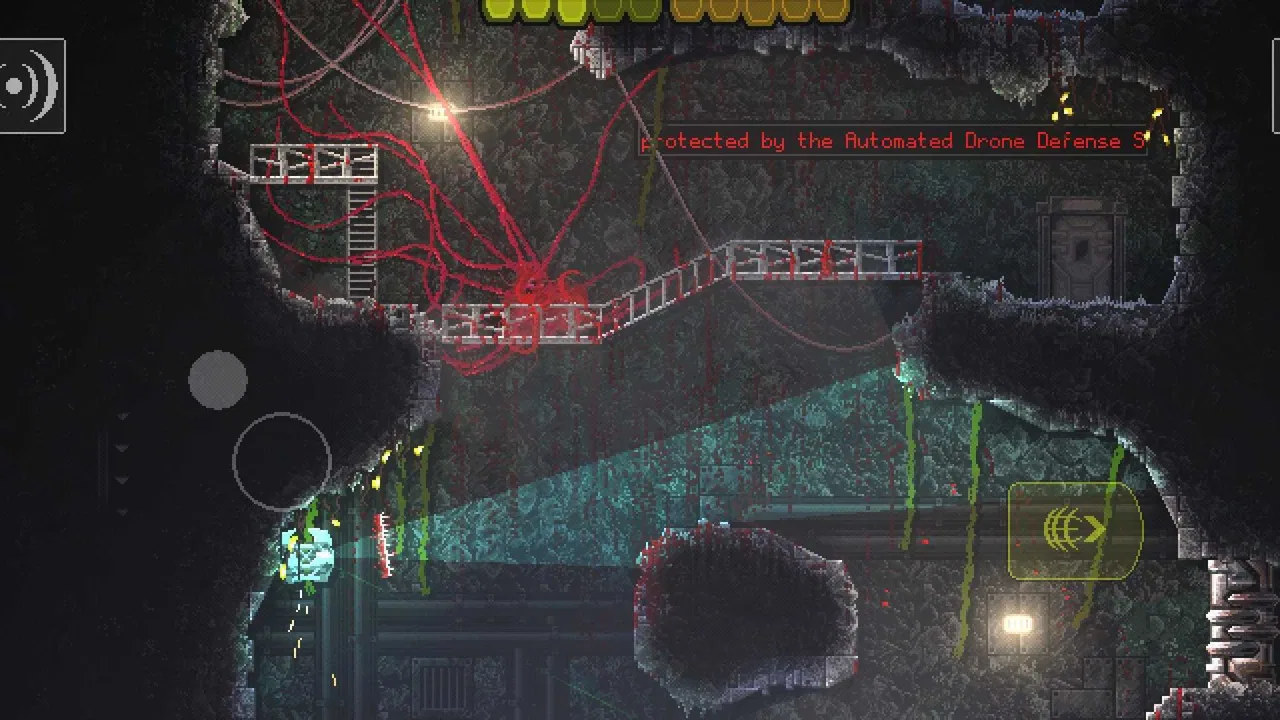
The art direction is one of the strongest reasons the game remains memorable. The pixel work is not merely a nostalgic filter placed over ordinary action. It gives the setting a grim, industrial identity and makes the creature’s silhouette easy to read against the surrounding structures. That clarity matters because the action can become busy, yet I can usually tell where the monster is and how its body is occupying the room.
The environment communicates through contrast. Hard surfaces, dim interiors, and human-made spaces frame the creature as an intrusion rather than a resident. I get the impression of a place built for containment and control, while the monster represents something that refuses to stay within those boundaries. Even without stopping to inspect every scene, I can read the setting as a conflict between rigid architecture and organic movement.
One of the less obvious strengths is how the visual style supports navigation. Because the game uses a strongly defined palette and recognizable shapes, I can often remember a room by its visual structure instead of relying on a map in my head. A doorway, barrier, vertical shaft, or open chamber becomes part of the route’s visual vocabulary. That helps when I return to an area and need to reconsider how I approached it earlier.
The art also protects the game from becoming visually exhausting. A more realistic presentation might make the violence harder to parse or turn every encounter into a noisy blur. Here, the abstraction keeps the action readable while preserving an unpleasant edge. The creature looks grotesque, but the pixel treatment creates enough distance for the experience to remain playable rather than simply oppressive.
The setting rewards attention without demanding sightseeing
I would not describe the world as a conventional exploration showcase. Its purpose is not to make me stop for scenic views. Instead, the setting creates a consistent pressure around the movement and combat. Rooms feel like parts of a hostile system, and the visual design encourages me to ask how the space can be used rather than what collectible might be hidden in a corner.
This is where the game differs from brighter action platformers. Those games often use color and animation to make every route feel inviting. Carrion’s presentation makes routes feel suspicious. A quiet section can be as important as a violent one because the lack of immediate activity gives me time to notice the structure around me. I learned not to rush through calm spaces; they often prepare the next decision.
My practical tip is to pause mentally at the edge of a new area and identify the room’s broad shape before attacking. Look for where the creature can pass, where enemies have a clear view, and which parts of the architecture might separate one threat from another. This is not a formal planning mode, but taking a second to read the screen can prevent the kind of reckless mistake that makes the action feel unfair when it was actually my fault.
Sound and rhythm make the horror playable
The sound design gives the game much of its physical personality. The creature’s presence is not carried by visuals alone; its movement and attacks have a weight that helps me understand what is happening even when several things overlap on screen. That audio feedback makes the monster feel less like a cursor and more like a body pushing through an environment.
The contrast between the creature and the human setting is especially important. Mechanical surroundings and human activity create one kind of sonic identity, while the monster’s noises cut across it. That opposition reinforces the story without needing constant dialogue. I feel that I am entering a controlled place and disrupting its order, not simply clearing another sequence of action rooms.
The pacing benefits from restraint. If every moment were loud and frantic, the creature’s attacks would lose their impact. Quieter passages give the next burst of movement more force, while sudden resistance can make a familiar route feel newly threatening. I found myself using sound as an early warning that a situation was changing, which made me less dependent on staring at every corner of the screen.
This rhythm is also why the game may not suit everyone. Players who prefer constant, fast scoring action might find the pauses too deliberate. Carrion often wants me to absorb the room, make a choice, and then deal with the consequences. The satisfaction is not only in speed; it is in the transition from stillness to violence and back again.
How to play when the atmosphere is doing the work
I recommend using headphones when possible, especially during a first playthrough. The audio helps preserve the separation between the creature and the facility, and that separation is central to the mood. Playing with distractions around me makes the game feel flatter because I lose some of the cues that tell me whether I am moving safely or entering a more dangerous exchange.
At the same time, I would not call the sound design a substitute for mechanical awareness. Audio can signal that something is happening, but it does not remove the need to understand the room. If I rely on noise alone, I can still overextend, become surrounded, or miss a better route. The strongest experience comes from combining the visual layout with the soundscape rather than treating either one as a complete warning system.
Mechanics that connect hunger, growth, and problem-solving
The game’s core loop works because progression is tied to behavior. Hunting and consuming are not decorative themes pasted onto a standard action framework. They are the actions that let me continue developing the creature and approaching later obstacles with a broader set of options. That creates a useful trade-off: I want to be aggressive, but I also need to be deliberate about where and when I spend that aggression.
Growth changes the way I think about familiar situations. Instead of simply asking whether I can defeat an enemy, I start asking whether I can separate threats, find a safer angle, or use the environment to reduce the risk. This is a more interesting form of power progression than a plain increase in damage because it encourages experimentation. A new capability matters most when it changes my understanding of a room.
One advanced habit I developed was to treat retreats as part of the plan rather than as failures. When an encounter becomes crowded, pulling back can restore control and let me approach from a different direction. The creature’s mobility makes escape feel like an active decision, not merely a reset. This is particularly useful for players who tend to commit to the first attack they see; leaving a fight can create a better opportunity than forcing it.
Another useful trade-off is between immediate consumption and safer positioning. The most obvious target is not always the best target if reaching it exposes the creature to several threats at once. I had better results when I considered the order of actions: isolate what I could, use openings created by movement, and only then take the reward. That sequence makes the game feel closer to hunting than to ordinary room clearing.
The controls are also central to whether the game works for you. On a touch device, an unusual creature can be harder to guide than a simple humanoid character because its shape and movement invite more continuous input. I found that short, intentional movements were more reliable than frantic swipes. Players with larger screens or a controller-friendly setup may find precise positioning more comfortable, while anyone using a smaller phone should expect a learning period.
This is one of the clearest situations where another option may be better. If I want an action game built around instant, highly precise touch reactions, a conventional platformer with a compact character may feel cleaner. Carrion asks me to manage a body that spreads through space, so the control challenge is part of its identity, but it can also be the main source of friction.
Who should play it and who should skip it
I would recommend it to players who like atmospheric action, unusual protagonists, environmental problem-solving, and games that trust them to learn by trying. It is particularly appealing if the idea of turning horror imagery into a playable tool sounds more interesting than playing another soldier or superhero. The combination of pixel art and creature movement gives it a personality that is difficult to confuse with a standard action release.
I would skip it if I am looking for a lighthearted game, a competitive multiplayer experience, or a title that can be enjoyed without paying attention to the screen. The Mature 17+ rating is also a meaningful signal about its tone. The creature, violence, and unsettling presentation are not occasional decoration; they define the experience. Anyone sensitive to body horror should know that the game’s central fantasy is intentionally disturbing.
The free price makes trying it easier, but it does not make the game universally suitable. I still need to be comfortable with its atmosphere and touch controls. I also would not choose it as a replacement for a large, open-ended action adventure. Its strength is concentration: a focused setting, a distinctive creature, and a progression loop built around mastering the relationship between movement, appetite, and danger.
Does the atmosphere hold together from start to finish?
In my view, yes, because the presentation and the mechanics are pulling in the same direction. The pixel art makes the creature readable and alien, the setting frames it as a breach in a controlled system, and the sound gives each movement a physical presence. Meanwhile, the mechanics ensure that the fantasy is not passive. I am not just watching a monster invade; I am learning how that monster survives.
The pacing is a major part of that success. Quiet movement, sudden attacks, tactical retreats, and moments of growth create a rhythm that feels closer to a horror chase than to a conventional action sprint. The game knows that menace becomes less effective when it is constant, so it gives me enough space to anticipate the next threat. That anticipation is where much of the tension lives.
There is still friction. Touch controls may require patience, and players who want uninterrupted action can find the deliberate sections slow. The dark, mature tone will also narrow its audience. I sometimes wanted a clearer sense of direction when moving through connected spaces, but that uncertainty is partly responsible for making the setting feel like a place I am infiltrating rather than a sequence of neatly labeled stages.
My final recommendation is straightforward: try Carrion if you want an action game with a genuinely different point of view and a mood that is carried by every major design layer. Play with attention, learn to retreat, and read the architecture before treating every room as a target. If you do that, the creature’s hunger becomes more than a visual joke. It becomes the organizing principle for movement, combat, progression, and atmosphere.
For me, the best achievement is that the game makes its setting playable. The industrial spaces, unsettling creature, sharp audio contrast, and measured rhythm are not separate decorations. They explain how the game wants me to think. Its strongest moments arrive when art direction and mechanics become the same language: the world looks hostile because it is hostile, and I survive by learning how to move through it as the threat everyone else fears.
FAQs for Carrion
01What is Carrion, and what kind of game is it?
Carrion is a reverse-horror action game in which you control an amorphous red creature rather than a human hero. You escape from a secretive research facility, hunt the people responsible for your imprisonment, and grow stronger by absorbing biomass. The game combines exploration, platforming, puzzle-solving, and fast combat, creating a distinctive experience built around movement and predatory abilities.
02Is Carrion available on Android or iOS?
Before downloading, check the current availability for your specific device and region, because Carrion’s mobile release status may differ between Android and iOS storefronts. The game has traditionally been associated with PC and console platforms, so users should rely on the official Google Play Store or Apple App Store listing rather than unofficial APK files or misleading download pages.
03Is Carrion suitable for children?
Carrion is generally aimed at mature players because it contains graphic violence, blood, creature-based attacks, disturbing imagery, and horror themes. Although the visual style is pixel-based, the game’s core mechanics involve hunting and consuming human enemies. Parents should review the platform’s age rating and content description before allowing younger players to install or play it.
04Does Carrion require an internet connection to play?
Carrion is primarily designed as a single-player experience, so its main campaign does not depend on online multiplayer or constant interaction with other players. However, an internet connection may still be needed to download the game, verify a purchase, install updates, or restore access through the relevant app store. Offline functionality can vary by platform and version.
05What should I know about Carrion’s gameplay and difficulty before downloading?
Carrion focuses on controlling a fast, flexible creature that can crawl across surfaces, squeeze through narrow spaces, ambush enemies, and unlock new abilities. Progression often requires experimenting with powers and finding alternate routes through the facility. The controls are unusual at first, and some puzzles or combat encounters can be challenging, but the game rewards exploration and creative movement rather than straightforward attacks.
Pros
- Distinctive reverse-horror gameplay puts you in control of the monster.
- Creative creature abilities make exploration and combat feel varied.
- Pixel-art visuals and animations create a memorable gruesome atmosphere.
- Compact level design encourages backtracking without feeling overly massive.
- Excellent sound design makes movement
- attacks
- and discoveries feel impactful.
Cons
- Some platforming sections can feel awkward with the creature’s unusual movement.
- The campaign is relatively short compared with many larger action games.
- Limited guidance may leave players unsure where to go next.
- Frequent backtracking can become repetitive near the later stages.
- The intense gore and horror themes may not suit every player.

Carrion
Gallery